Groundhog Day
The hidden story beneath Bill Murray's classic comedy.

On the surface, Groundhog Day is a comedy about a man stuck reliving the same day. But if we take a symbolic attitude toward the story—if we imagine it as an inner drama unfolding inside one human psyche—the film changes from a waking-life comedy of errors to a map of personal integration.
Phil Connors is not just a TV weatherman stuck in Punxsutawney. He is an ego that refuses to relate to other parts of the psyche. The people he encounters over and over again are not merely colleagues and townspeople—they are aspects of his own personality he hasn’t yet learned to recognize or accept.
In Groundhog Day, the supporting characters never change. What changes is Phil’s relationship to them. And through those changing relationships, we watch a personality gradually integrate its parts and realize a more balanced way of being.
The cast of Phil’s inner world
There is Larry, the cameraman—a humble, good-humored everyman who is content in his ordinariness and (as a result) warm and connected to the people around him. Larry represents the ordinary, grounded part of Phil himself—the part that can find belonging anywhere.
There is Rita, Phil’s producer and eventual love interest—kind, curious, and playful. She represents Phil’s own capacity for relatedness, empathy, and sincerity, qualities Phil initially dismisses as naïve before admitting his admiration for them later in the story.
There is Ned Ryerson—the relentlessly cheerful insurance salesman Phil is always desperate to escape. Ned embodies Phil’s disowned enthusiasm and emotional transparency, the eager, uncool part of himself he learned to reject long ago.
There are the townspeople—the waitress, the clerk, the newlyweds, the strangers he passes each morning. They represent the ordinary human life Phil secretly fears he has fallen into: routine, community, limitation, belonging.
And then there is the old homeless man Phil repeatedly encounters and eventually calls “Father.” He symbolizes Phil’s own destitute capacity for fathering—himself or anyone else.
Each of these figures is part of Phil. Like so many inner dramas, the story unfolds in three acts as his relationship to these parts slowly change.
Act I: The All-Conquering Ego Can Go No Further
At the beginning of the film, Phil moves through the world as if everything exists for his convenience. Larry is someone to mock. Rita is someone to impress or seduce. Ned is someone to escape. The townspeople barely register.
Symbolically, Phil is an ego that refuses relationship with any inner part that does not serve his grandiose self-image (when I say “inner part” think: needs, feelings, instincts, or personality traits). Anything ordinary, vulnerable, enthusiastic, or emotionally open is mocked, pushed away, or ignored completely.
When the day starts repeating, Phil first reacts with frustration and anger at the inconvenience. How could this be happening to me?
Quite quickly, however, he begins treating his newfound perspective as a loophole. With consequences removed, he indulges himself. He manipulates people, steals money, seduces women, eats excessively, and treats the entire town as a movie set in which he is the only character of any consequence.
Even Rita becomes a puzzle to solve. Phil memorizes her preferences and performs them back to her, trying desperately to manufacture intimacy. But each attempt fails. Performance simply will not substitute for genuine relatedness.
The first act is summarized by the Sir Walter Scott poem Rita quotes to Phil at the Tip Top Diner:
The wretch, concentred all in self,
Living, shall forfeit fair renown,
And, doubly dying, shall go down
To the vile dust, from whence he sprung,
Unwept, unhonored, and unsung.
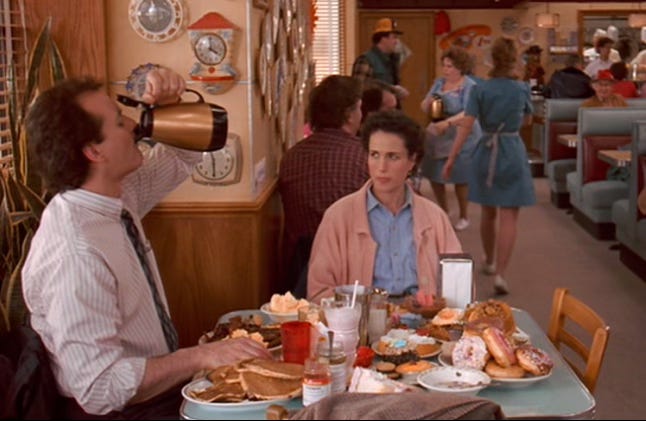
Eventually, predictably, pleasure becomes hollow. The sense of control Phil has worked so hard to establish no longer brings relief. Despair sets in and Phil begins a long string of suicides—but to no avail. There is no escape. As they say in 12-step programs, Buckaroo Bonzai, and meditation retreats: “Wherever you go, there you are.”
Phil is right that something needs to die—but it’s not a literal death he needs, it’s a symbolic one. His way of being needs to die so that a new way of being can be born.
Act II: From Control to Collaboration
The turning point arrives only after Phil has exhausted every possible means of control and escape. This is what Carl Jung meant when he wrote, “People will do anything, no matter how absurd, to avoid facing their own soul.”
Lying in bed reading poems to Rita, Phil finally accepts that his egocentric way of being will take him no further. Quoting Joyce Kilmer, he concedes, “Only God can make a tree.” This is the essential shift from control to collaboration. The ego accepts it is a steward of psyche’s growth, but not its source.
The next day (Groundhog Day, again) Phil starts treating his parts with respect and decency. Larry’s ordinariness becomes a comfort rather than a punchline. Ned’s enthusiasm is met and shared instead of avoided. The townspeople become beloved neighbors instead of nameless extras.
As Phil welcomes these parts back, he finds himself filled with creative energy. He takes piano lessons. Practices ice sculpting. He even begins helping strangers—something unimaginable for Phil when the story began. This new attitude is especially pronounced with the old homeless man.
Earlier in the story, Phil ignored the homeless man or patted his pockets, half-heartedly miming a search for change. Now, Phil approaches him with compassion saying, “Hello, father. Let’s get you someplace warm.”
It’s a tender moment. But despite Phil’s help, the old man passes away in the hospital. “Sometimes people just die,” the nurse offers. “Not today,” Phil says. The essence of fatherhood is protecting life in all its forms. And this first-hand experience of an unprotected life being lost constellates a new determination in Phil, a new sense of responsibility. He becomes a man on a mission.
The montage that follows shows Phil nurturing the old man any way he can: feeding him warm meals, buying him clothes, even performing CPR on him (symbolically, breathing life into the part he calls “father”).
On the surface, we see Phil learning a painful lesson about mortality. But underneath, we are watching Phil gradually integrate his own capacity for fathering. In symbolic language, when something “dies” it has been reintegrated. By the time the montage is complete, Phil’s transformation is as well.
Act III: Balance is Restored, Life Moves Forward
The next morning (still Groundhog Day) Phil appears as a beloved pillar of his newfound psychic community. All his parts are gathered around him at Gobbler’s Knob. Every other TV station has ceased their own broadcasts and pointed their microphones toward him. The town is focused on him—he is focused on them.
With a twinkle of belonging in his eye, Phil waxes poetic: “When Chekhov saw the long winter, he saw a winter bleak and dark and bereft of hope. Yet we know that winter is just another step in the cycle of life. But standing here among the people of Punxsutawney and basking in the warmth of their hearths and hearts, I couldn’t imagine a better fate than a long and lustrous winter.”
This is an image of inner harmony. Symbolically, the ego is no longer at war with the rest of the psyche. Ordinariness, vulnerability, enthusiasm, creativity, and relatedness all find their place. After the broadcast, Phil darts around town serving others—and seeking nothing in return. He saves falling children, changes flat tires, and performs the Heimlich maneuver on the mayor. Everyone seems magnetically drawn to him.
This is the part in fairytales where peace is restored to the kingdom.
After several long scenes without her, Rita returns and buys a date with Phil at the Groundhog Festival’s charity auction (far outbidding others to do so). Phil is no longer a manipulator pursuing Rita, he has become the kind of man she is drawn to of her own accord. Standing in the lobby afterward, a single frame encapsulates Phil’s transformation.
For just a moment, Phil stands hand-in-hand with Rita, smiling warmly at Ned. Behind him, a square blue quilt bearing four groundhogs (in symbolic language, the number four is often related to wholeness) frames his face like a stained-glass window. The big city business suit he wore at the beginning has been replaced by an earthy brown blazer and a blue collarless shirt reminiscent of something a minister would wear. A curmudgeon who began the movie saying, “This is pitiful. A thousand people freezing their butts off, waiting to worship a rat,” has become a loving father to a beloved community.

At long last, the repetition stops because it is no longer needed. Phil wakes into the next day because he has finally learned how to live in this one.
The story beneath Groundhog Day suggests something that is both comforting and demanding: life changes when we learn to relate differently—not just to others in our waking lives, but to the inner parts of ourselves we’ve been trying to escape. That work belongs to all of us.