Arrival
A modern masterpiece teaches us another way to see.

When alien ships first appear in Arrival, the world does not respond with curiosity. It responds with security (we’ve all been there).
Schools empty (learning stops). Governments mobilize (authority protects). Protocols are activated (complexes trigger). Every action seeks safety and control (fight or flight). The question on everyone’s mind: What do the visitors want?
It’s a reasonable question, if a defensive one. When something unknown interrupts our world (inside or out), we tend to perceive it as a threat.
Take a moment to reflect: Have you ever been chased by something in a dream? It no doubt felt terrifying, but are you certain it meant you harm? Did you ever wonder if that something might need your help?
When Louise and Ian first meet in the helicopter, Ian quotes the introduction of her book: “Language is the foundation of civilization. It is the glue that holds a people together. It is the first weapon drawn in a conflict.”
Before we’ve even met the aliens, two attitudes toward this mystery have already emerged: one wants relationship (glue); the other, control (weapon).
A new attitude
In navigation, attitude refers to the orientation of a vehicle to a fixed frame of reference. For example, where an airplane’s nose is pointed and how its wings are tilted relative to the ground or the horizon.
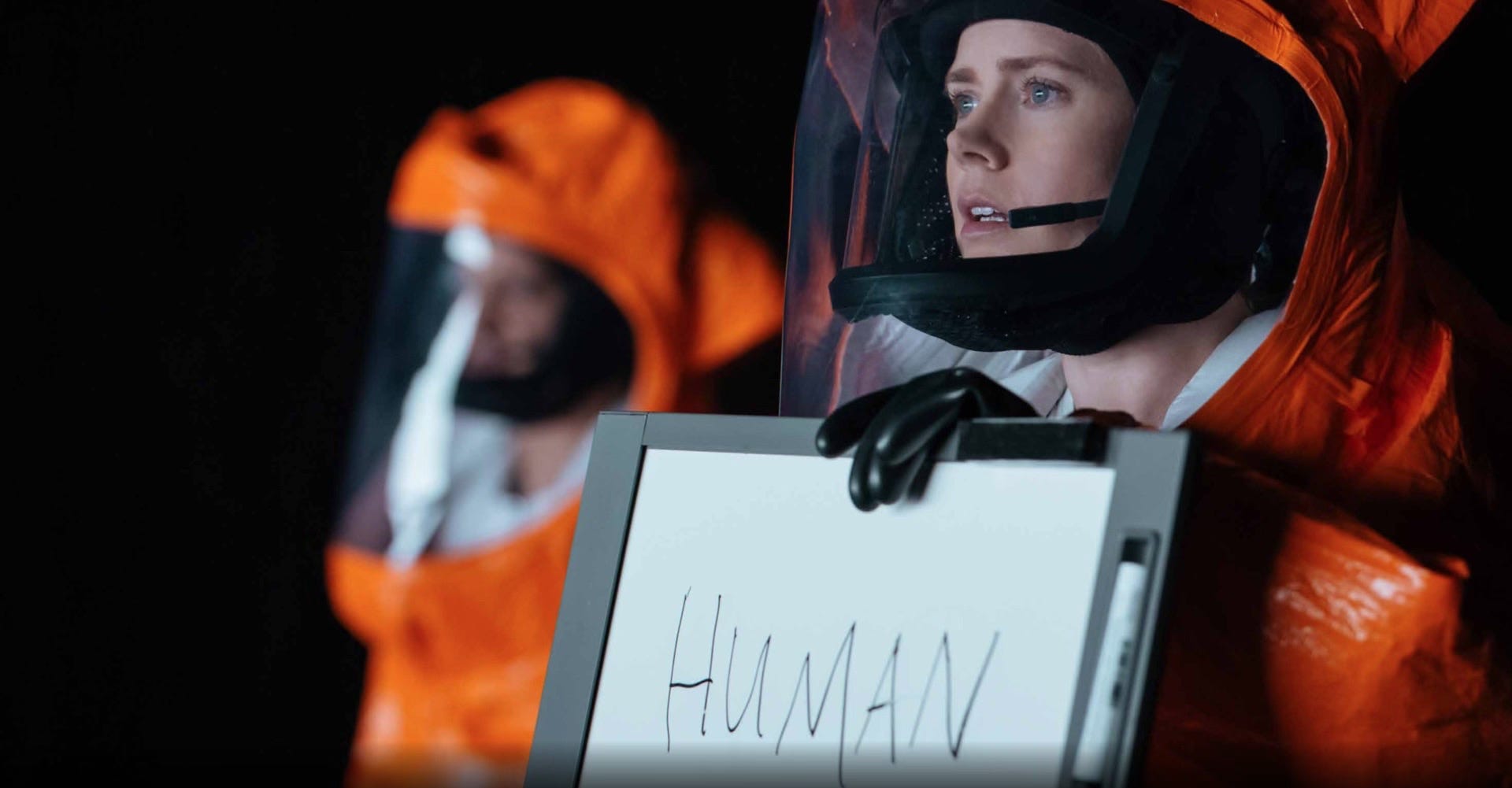
Each time humans enter the alien ship, the change in gravity requires a change in attitude—quite literally, up and down are no longer up and down. Stiff in their protective orange suits, Louise and Ian struggle to orient themselves as walls become floors.
Of course, it’s not just a physical disorientation, it’s psychological as well. When the heptapods finally emerge behind the translucent barrier—massive, tentacled, mysterious—the room is stunned into silence. As the military doctor says of the previous language expert (who we see carted off via medivac): “Not everyone is able to process experiences like this.”
Slowly but surely, however, Louise is able to process her experiences. And the new attitude she is developing becomes embodied in the third session (third time’s a charm) when she removes her protective suit. Everyone around her panics, but she reassures them: “It’s okay. They need to see me.”
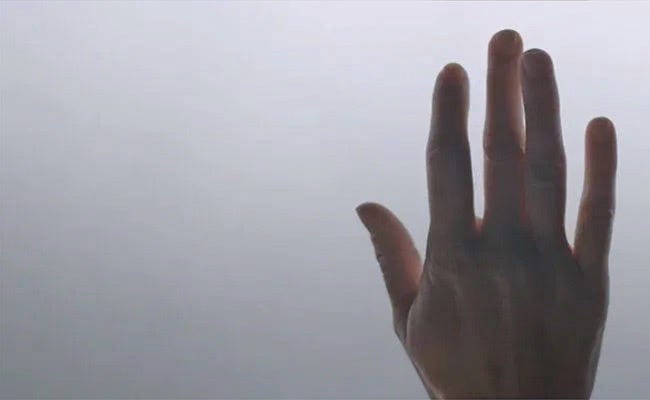
Louise approaches the screen, exhales, and smiles like she’s just arrived home. Exposed, vulnerable, visible, Louise places her palm on the glass. The heptapod mirrors her and emits a seismic groan.
Louise says reverently, “Now that’s a proper introduction.”
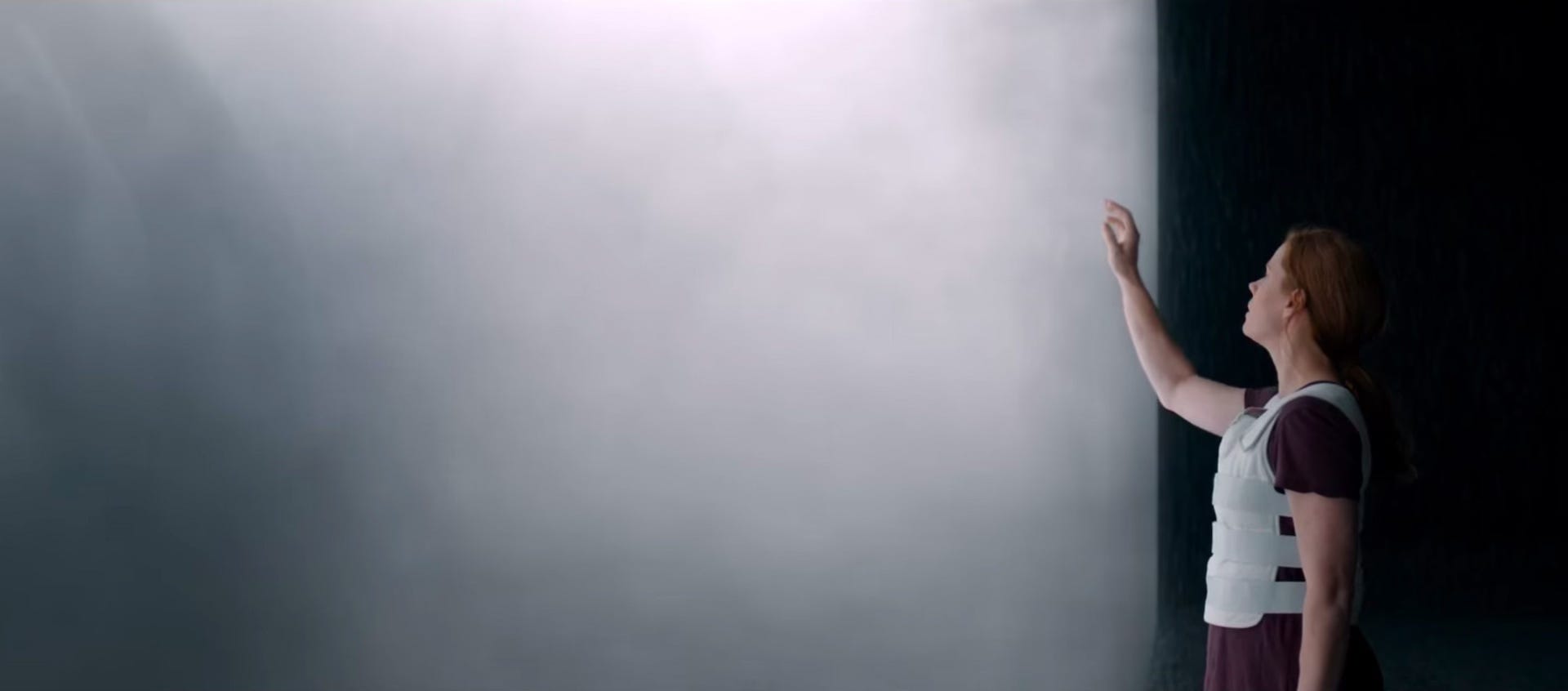
In that simple gesture, something changes. The world has not become safer. The heptapods have not revealed their intentions. But the attitude has shifted. The scales are tilting away from control and toward relationship.
A language outside of time
As Louise works with the heptapods’ written language, she discovers it does not operate the way that human language does. Their writing conveys meaning—it does not represent sound. Each logogram (symbol) appears complete from the moment it is formed, conveying an entire idea or process all at once.
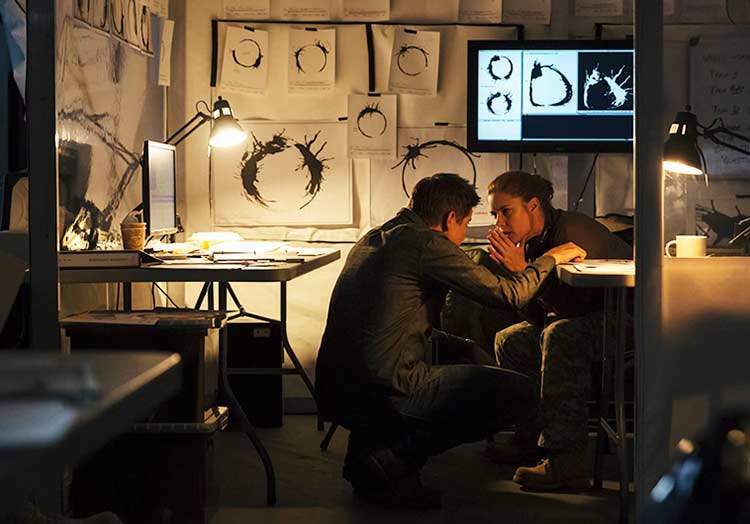
And, as Ian notes, “Unlike speech, a logogram is free of time. Which raises the question: Is this how they think?”
This discovery is not merely linguistic. It is experiential.
As Louise immerses herself in their symbols, her perception begins to shift. She experiences a series of flash-forwards: standing with a young girl petting a horse (a symbol of the human psyche); then, the same young girl in a field of flowers playing with a caterpillar (a symbol of transformation); and then, that same young girl turning over rocks along a lakeshore (a symbol of inner work).
At first, these visions destabilize Louise. She slips out of the present, overwhelmed and disoriented. The future intrudes like a memory she cannot place. But gradually she begins to hold both perspectives at once.
The symbolic lens does not eliminate linear time. It does not erase cause and effect. Instead, it adds another dimension to our experience.
For Louise, studying the heptapod language makes it possible for present and future to coexist within her awareness. She does not float above practical reality; she inhabits it more fully, seeing its larger pattern.
Later, her daughter asks why her name is Hannah. “Because it’s a palindrome,” Louise replies. “It reads the same forward and backward.” The name becomes an emblem of her altered perception.
To learn the heptapod language is to access a way of seeing in which events are not isolated fragments but parts of a whole. It is not an escape from reality. It is a deepening of it.
Weapon or gift?
The crisis escalates when Louise asks the heptapods their purpose and they answer: “Offer weapon.” These seemingly simple words set off everyone’s defenses. Nations sever communication. China prepares for conflict. A frightened infantryman, shaken by rhetoric and fear for his family, plants a bomb inside the heptapod ship.
Seeing “weapon” and assuming ill intent is not unreasonable. In human history, advanced tools have often been used as instruments of domination. The defensive response makes logical sense. But Louise argues that the heptapods don’t know the difference between a weapon and a tool. “Language and culture are messy,” she insists. “Sometimes one can be both.”
Eventually, she realizes the “weapon” is not a device but the heptapod language itself. “If you really learn it,” she explains, “you begin to perceive time the way they do.” Their great offering is not power over others but a transformation of perception.
This way of seeing doesn’t remove suffering or guarantee peace, it enlarges the frame in which suffering and peace are experienced and understood. The literal, surface-level lens keeps us alive by perceiving physical reality and assessing threats in a linear, stepwise way. The symbolic lens gives our lives meaning by perceiving patterns, authoring narratives, and contextualizing our place in a larger whole.
Both lenses are necessary. They do not cancel each other out. But one is great at grocery lists—and the other re-enchants the world.
For the scientifically inclined, these two ways of seeing more or less correspond to the hemispheres of the human brain (left linear, right contextual). If you’re interested in learning more about this, Iain McGilchrist’s The Master and His Emissary is a great starting point.
Holding two perspectives at once
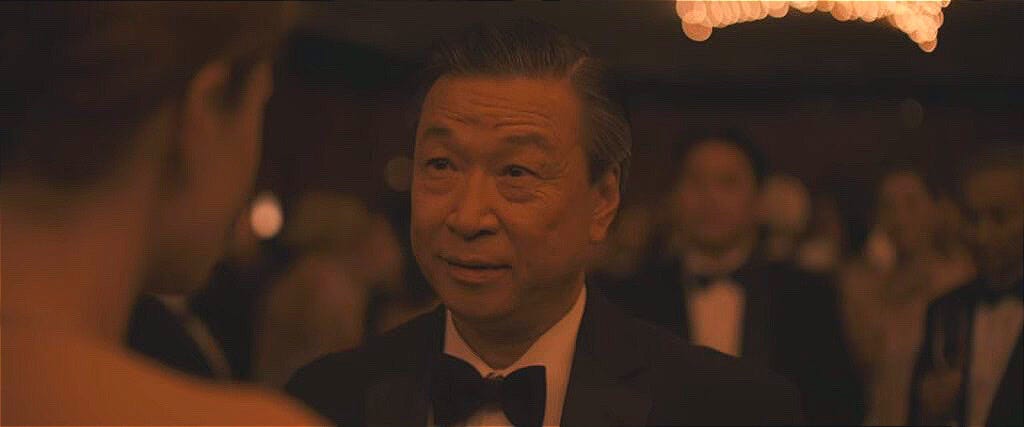
In the final act, Louise is no longer just experiencing visions of the future. She is acting from within them. She flashes forward to a “unification banquet” (a symbol of the inner marriage) where General Shang shows her his private number on a golden phone (the only golden object in the film—must be symbolically important!).
In the present, Louise searches for a satellite phone and calls General Shang using the number. “What are you doing?” Ian asks. “Changing someone’s mind,” she replies.
Louise now holds both perspectives—present and future—without collapsing into either. At the future banquet, Shang whispers his wife’s dying words into Louise’s ear. And in the present, Louise repeats those words to Shang over the satellite phone, saying in Mandarin: “In war there are no winners, only orphans and widows.”
At the future banquet, Shang steps back and whispers reverently: “Thank you. Thank you.”
In the present, General Shang orders China’s military to stand down. Other nations follow. News broadcasts tile across the screen announcing the good news, echoing the earlier cloud of heptapod symbols, and underscoring the fact that humans are also “one of many.”
Before dissolving from sight, the heptapod ships rotate horizontally—a symbolic gesture we could interpret many ways: a bow, a hug, an acknowledgement that heptapods and humans are now aligned, sharing a common attitude.
The enchanted world
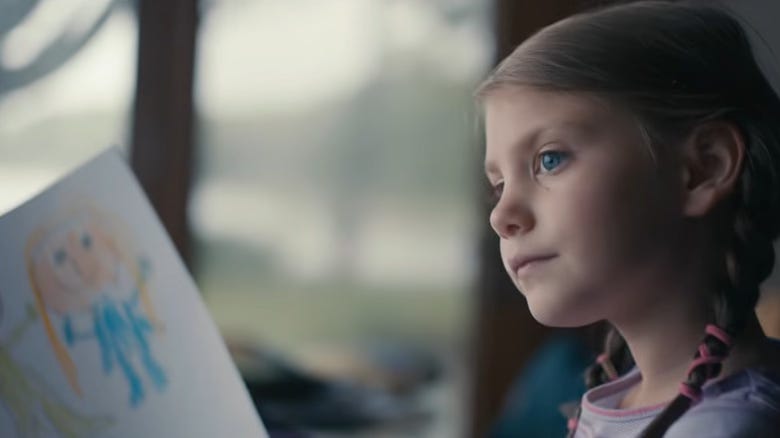
At the end of the film, Louise asks Ian a haunting question: “If you could see your whole life from start to finish, would you change things?”
She already knows her answer. She has seen the child who will be born, the illness that will come, the husband who will leave because he cannot bear what she knows. And she chooses it anyway.
Despite knowing the journey and where it leads, she embraces it.
This enlarged perspective does not make life easier. It makes life deeper. It does not remove grief; it situates grief within a pattern that reaches beyond the immediate loss. The world no longer appears as a random sequence of events but as a coherent story whose meaning transcends linear time.
As Yeats wrote: “The world is full of magic things, patiently waiting for our senses to grow sharper.” Or, as one itinerant rabbi put it: “You have eyes to see, but do not see.”
The symbolic attitude does not replace ordinary perception. It adds another way of seeing. It allows us to experience the dimension of meaning and eternity that pulses beneath the surface of everyday life. It does not deny danger or eliminate defense. It reminds us that beneath our protocols and protective suits lies a deeper invitation—a calling that never stops calling.
It asks us: Will you put your hand on the glass?
Enjoyable and insightful. Need to rewatch this.
Your beautifully written piece sparked something! I rewatched this, am listening to Sagan’s Contact, and hope to find more content tied to the Tower of Babel mythos & the disintegration of tribes in favor of life collective.